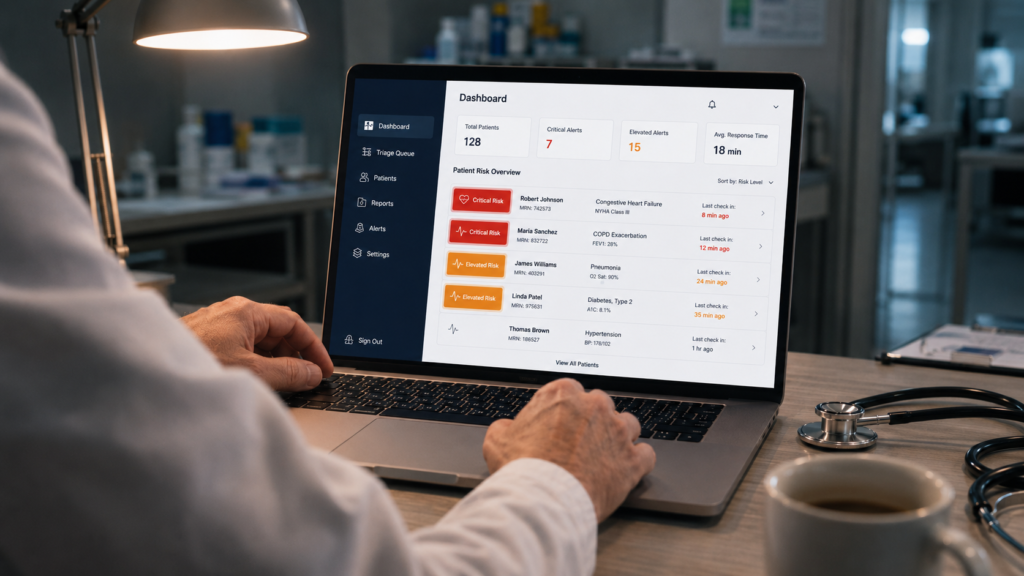
I stumbled on BetweenVisits.org a little while back and, honestly, I couldn’t stop thinking about it. The premise is very simple. It’s an AI-powered patient monitoring platform built specifically for home care agencies, and its entire reason for existing is captured in one line from its homepage: catching decline before it becomes a crisis. That’s it. That’s the whole thing. And somehow, despite solving one of the most persistent and costly problems in all of healthcare, this site is flying completely under the radar.
This article is my attempt to change that. Because the problem BetweenVisits.org is targeting has been sitting right in front of the healthcare industry for decades, and the solution they’re describing is exactly what AI patient monitoring in the home care space should look like. If you’re working in health informatics, health IT, or anywhere adjacent to how patient data flows through post-acute care, you need to understand what’s being built here and why it matters.
The Problem That Lives in the Gap
Home care is fundamentally different from hospital care in one specific and dangerous way. When a patient is admitted to a hospital, they’re monitored constantly. Nurses check in regularly. Vitals are tracked. Alarms go off when something changes. The information density is high by design, because proximity to a deteriorating patient creates opportunities to intervene.
Home care works on the opposite model. A nurse or aide visits a patient at their home on a schedule. Maybe three times a week. Maybe daily. But that visit is the only structured window of clinical observation that patient gets. Whatever happens between those visits happens in the dark. No monitoring, no data, no alerts. Just the hope that the patient stays stable until the next scheduled check-in.
Research published in NCBI’s Patient Safety and Quality resource describes this gap directly: care encounters in home health typically happen days apart, compared to the minute-to-minute encounters in hospital settings (NCBI, 2008). That spacing creates a surveillance void that the current home care model has never figured out how to fill. Without the frequent assessments commonplace in hospitals, gauging whether a patient is improving or deteriorating between visits is genuinely difficult for any care team.
What BetweenVisits.org Is Building
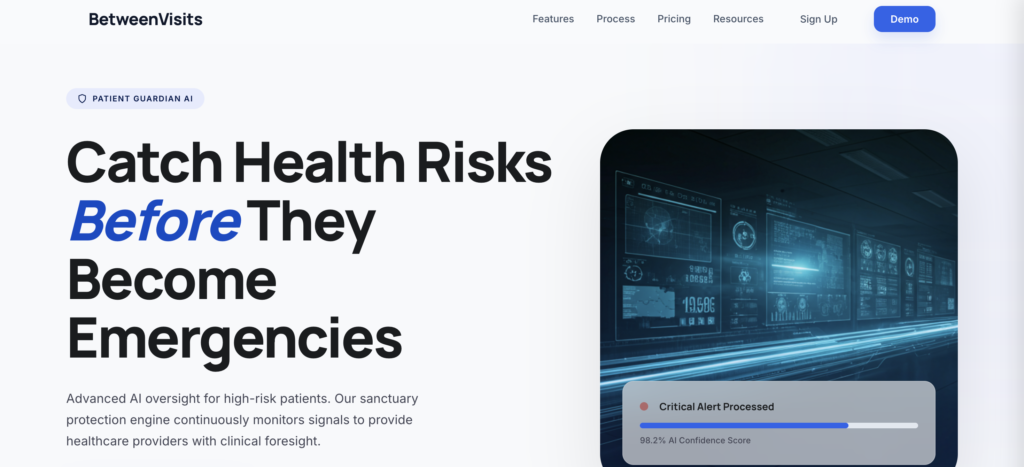
BetweenVisits.org describes itself as “AI-powered patient monitoring for home care agencies, catching decline before it becomes a crisis” (BetweenVisits, 2026). The target customer is the home care agency itself, not individual patients and not hospitals. That framing matters. Most remote patient monitoring tools on the market are either consumer-facing (apps patients use themselves) or hospital-facing (tools that plug into EHR systems and serve care teams in clinical settings). BetweenVisits is going after the specific, underserved layer of organizations that send nurses and aides into people’s homes on scheduled visits.
The name of the platform is the product strategy. The gap between visits is where patients fall through the cracks, and the platform is explicitly designed to fill that gap with AI monitoring that can detect changes in patient status before they escalate into hospitalizations or emergency department trips. That is a very specific problem statement, and specificity in healthcare technology is a feature, not a limitation. Tools that try to do everything for everyone in healthcare tend to do nothing particularly well. BetweenVisits chose a lane and stayed in it.
Why 30% Is an Unacceptable Number
Here is the number that should make every healthcare professional uncomfortable. Approximately 30% of home health care patients are hospitalized or visit an emergency department during a home health episode (NIH, 2021). That means nearly 1 in 3 patients receiving home care ends up in a higher-acuity care setting at some point during their episode. And research consistently estimates that 20 to 25% of those unplanned hospital admissions are preventable (NIH, 2021).
Preventable. Not “hard to avoid” or “somewhat reducible.” Preventable, given the right information at the right time.
The U.S. home healthcare services market was valued at approximately $155 billion in 2025 and is expected to grow to over $320 billion by 2035 (Nova One Advisor, 2026). We’re talking about a massive and growing segment of care delivery where 1 in 4 hospitalizations during a care episode might not need to happen at all if someone caught the warning signs earlier. That’s an enormous amount of preventable suffering and cost sitting inside a 10-year, doubling market.
The financial pressure is coming from the hospital side too. The Centers for Medicare and Medicaid Services penalizes hospitals for excessive 30-day readmissions through the Hospital Readmissions Reduction Program. In fiscal year 2026, approximately 2,400 hospitals faced some level of payment penalty under that program (Modern Healthcare, 2026). Hospitals are already under intense financial and regulatory pressure to keep patients from bouncing back. A home care platform that catches patient decline before it triggers a readmission is not just good clinical practice. It’s a direct financial benefit to the entire care continuum.
The Data Gap That AI Can Actually Fix
What makes this problem a good fit for AI is that the signals of decline often exist in the data long before a patient shows up in the emergency department. The issue has never been that the signals are invisible. The issue is that home care agencies haven’t had a way to collect, aggregate, and interpret those signals continuously between visits.
Research published in PMC examined whether machine learning algorithms applied to home health care narrative notes could identify patients at risk for hospitalization or ED visits. The conclusion was that it’s feasible and that these algorithms can flag deterioration risks from documentation patterns that a human reviewer reading individual notes would likely miss (PMC, 2022). The data is there. The problem is that it hasn’t been connected and analyzed in real time.
Other AI tools in adjacent spaces have shown what’s possible when you close that data gap. CareSightAI, a predictive tool tested by Team Select Home Care, consistently identified early signs of patient decline 3 to 5 days before an actual hospitalization occurred when applied to existing patient data (Team Select Home Care, 2024). That’s a 3 to 5 day window where an intervention could have prevented the admission entirely. BetweenVisits is targeting exactly that kind of proactive signal detection for the home care agency market.
The distinction worth understanding here is the difference between reactive monitoring and predictive monitoring. Reactive tools alert care teams when a patient’s condition has already changed. Predictive tools identify the trajectory of change before it arrives at a crisis point. The platform BetweenVisits is building fits the predictive model, and that’s the harder and more valuable problem to solve.
What This Means for Health Informatics
If you’re in health informatics, you might be wondering where your work intersects with a platform like this. The answer is: almost everywhere.
Home care has historically been one of the most data-poor segments of the care continuum. Clinical documentation practices in home care agencies vary widely. EHR adoption, while improving, is still not universal across smaller agencies. The data that does exist is often unstructured, living in nursing notes and visit summaries rather than discrete coded fields that analytics tools can easily consume. Interoperability between home care agencies and hospital systems is an ongoing problem. When a patient discharges from a hospital to a home care agency, the clinical information handoff is frequently incomplete, delayed, or both.
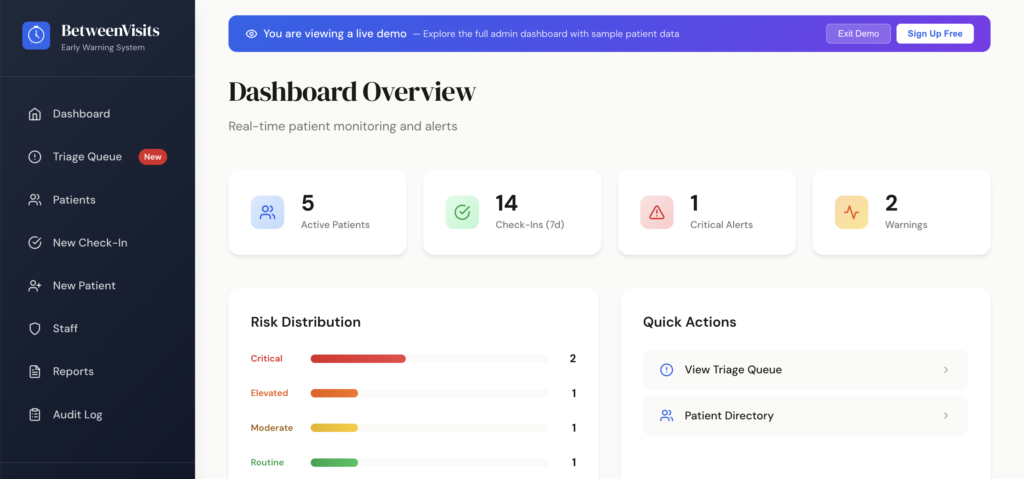
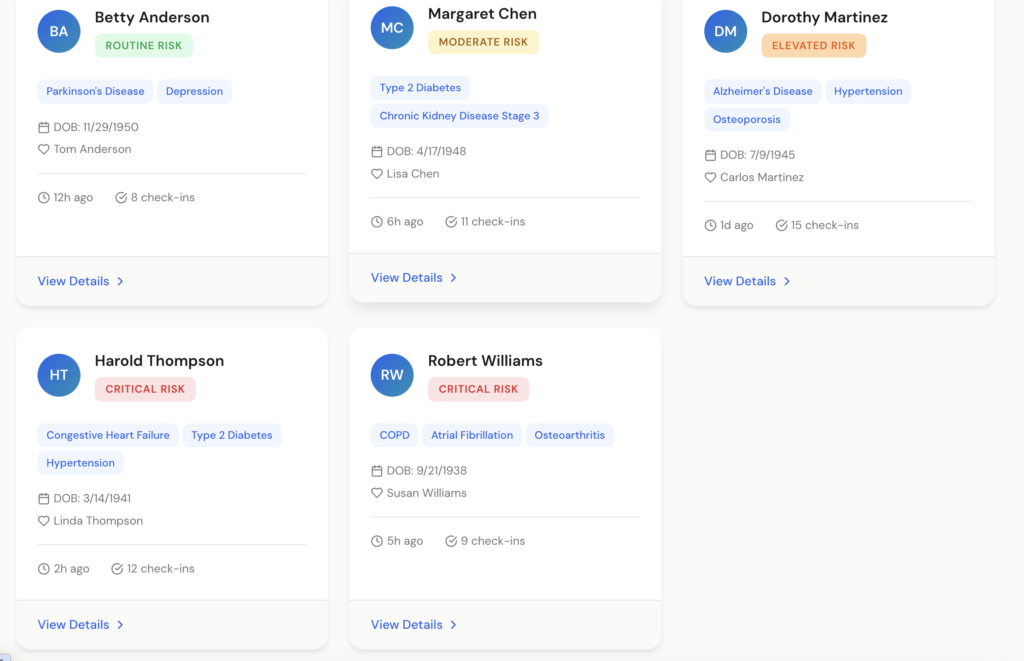
A platform that successfully monitors patients between home care visits has to solve all of these problems simultaneously. It needs to ingest and interpret clinical data in whatever form the agency generates it. It needs to apply AI models that can detect meaningful patterns in that messy, inconsistent data. And ideally, it needs to communicate actionable alerts back to care teams in a way that actually fits their workflow, not in a way that adds one more dashboard nobody checks.
That is a real informatics challenge. The clinical data model, the interoperability layer, the alerting logic, the integration with existing home care software platforms like Homecare Homebase or Axxess, the HIPAA-compliant data infrastructure required to run patient-level AI monitoring at scale. These are not trivial problems. They’re exactly the kind of problems that health informatics professionals are trained to think about and solve. A company building this kind of platform needs people who understand HL7, FHIR, clinical workflows, and data governance. The emergence of platforms like BetweenVisits is creating demand for that skill set in a part of the market that has never had much of it.
Why It’s Still Flying Under the Radar
Part of why BetweenVisits.org is underrated is structural. Home care agencies are not sexy clients for tech companies. They’re often small businesses, operating on thin margins, with limited IT infrastructure and limited budgets for new software tools. The hospitals and large health systems attract most of the healthcare AI investment and most of the press coverage. Post-acute care, and home care in particular, tends to be an afterthought.
But that’s starting to change. The aging population is not a trend, it’s a demographic certainty. The number of Americans 65 and older is projected to nearly double between 2016 and 2060, from 49 million to 95 million (U.S. Census Bureau, 2017). More older adults means more home care demand. More home care demand means more pressure on agencies to demonstrate quality outcomes. More pressure on quality outcomes means more need for tools that can actually measure and improve what happens between visits.
The agencies that start using AI patient monitoring now are the ones that will have the data infrastructure, the quality metrics, and the outcome track record to compete effectively in a market that is about to get a lot more competitive and a lot more outcomes-focused. BetweenVisits found the right problem at exactly the right time. The market just hasn’t caught up yet.
The Quiet Hours Are Where Healthcare Gets Won
Here’s what I keep coming back to with BetweenVisits.org. The highest-risk moments in a home care patient’s episode are not the moments when the nurse is in the room. Those moments are covered. The highest-risk moments are the 48 or 72 hours between that visit and the next one. Those are the hours when a slow decline in fluid balance tips into pulmonary edema. When a subtle change in gait becomes a fall. When a patient who seemed fine on Tuesday shows up in the emergency department on Thursday.
That is the gap that healthcare has never solved at scale. BetweenVisits is going after it directly, in the specific market segment where the gap is widest, with AI that is designed to do the one thing home care agencies most need: see what’s happening when nobody is there to see it.
That’s worth paying attention to. Keep an eye on it.
References
BetweenVisits. (2026). BetweenVisits — AI Patient Monitoring. https://betweenvisits.org/
Topaz, Maxim et al. “Home Healthcare Clinical Notes Predict Patient Hospitalization and Emergency Department Visits.” Nursing researchvol. 69,6 (2020): 448-454. doi:10.1097/NNR.0000000000000470
Nova One Advisor. (2026). U.S. Home Healthcare Market Size to Exceed USD 320.69 Billion by 2035. https://www.novaoneadvisor.com/report/us-home-healthcare-market
Modern Healthcare. (2026). CMS Release Hospital Readmission Penalties for Fiscal 2026. https://www.modernhealthcare.com/providers/mh-cms-hospital-readmission-penalties-2026/
PMC. (2022). Home Health Care Clinical Notes Predict Patient Hospitalization and Emergency Department Visits. https://pmc.ncbi.nlm.nih.gov/articles/PMC7606545/
PMC. (2022). Capturing Concerns about Patient Deterioration in Narrative Documentation in Home Healthcare. https://pmc.ncbi.nlm.nih.gov/articles/PMC10148365/
Team Select Home Care. (2024). AI Predictive Care at Home. https://tshc.com/caresight-ai-predictive-care/
U.S. Census Bureau. (2017). Older Americans Month: Facts for Features. https://www.census.gov/newsroom/facts-for-features/2017/cb17-ff08.html
More Articles on Informessor
1 in 3 Home Care Patients End Up Hospitalized. This AI Platform Is Built to Stop That.
I stumbled on BetweenVisits.org a little while back and, honestly, I couldn’t stop thinking about…
How Ambient AI Scribes Are Reshaping Health Informatics Careers in 2026
There’s a quiet revolution happening inside exam rooms across the country, and most people outside…
Top Health Informatics News From Q1 2026: What You Need to Know
Health informatics had a busy 1st quarter in the US, and honestly, a lot of…

The Hidden Costs of Bad Data in Healthcare
In hospitals, healthcare data is not just a record of what happened. It is the input that…
How Health Informatics Transforms Patient Outcomes
If you have ever wondered why a correct diagnosis does not always translate into better…
Healthcare Data Quality Framework to Fix Broken Dashboards
If you have ever shipped a dashboard you were proud of, only to watch it…