
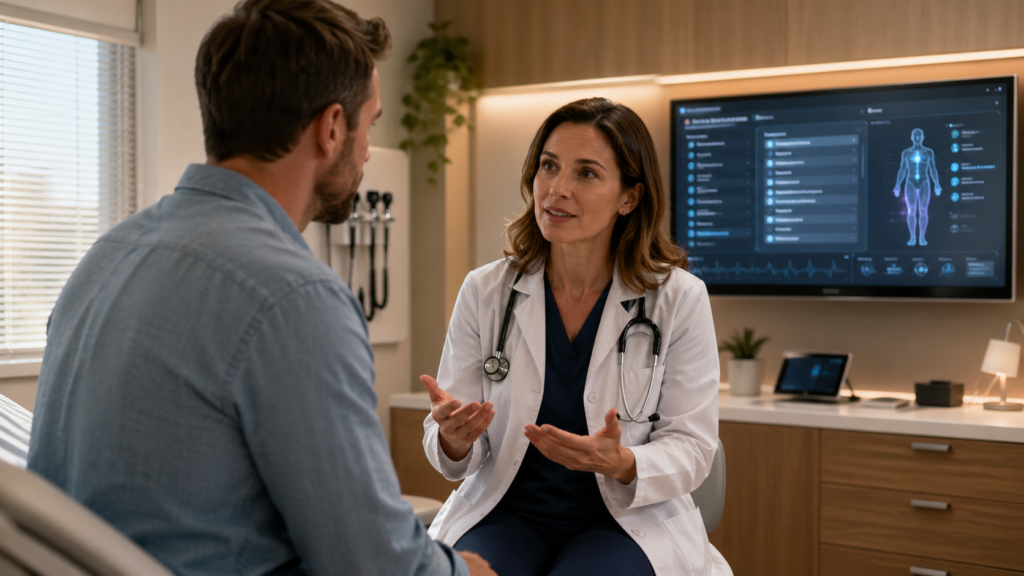
There’s a quiet revolution happening inside exam rooms across the country, and most people outside healthcare have no idea it’s going on. Ambient AI scribes are now being deployed at scale across major health systems. These tools listen to clinician-patient conversations in real time and automatically generate clinical notes. And they are creating both a major opportunity and a serious responsibility for health informatics professionals.
If you’re working in health informatics or trying to break into the field, this is not a trend to monitor from the sidelines. It’s one shaping job descriptions, team structures, and skill requirements right now in 2026.
What Ambient AI Scribes Actually Are
Ambient AI scribes are software tools that use automated speech recognition and natural language processing to capture what’s said during a clinical encounter and convert it into a structured visit note. Unlike older voice-to-text tools where a clinician had to speak directly into a microphone, ambient scribes just listen to the room. The clinician talks to the patient. The AI does the rest.
Most of the widely deployed tools, like Microsoft’s Dragon Copilot and Nuance’s DAX, integrate directly into existing electronic health record systems. They are designed to work inside the clinical workflow rather than require a separate process. That integration piece is where health informaticists become essential.
The Numbers That Make This Real
The adoption of ambient AI scribes has picked up fast, and the results coming out of real-world implementations are hard to argue with. At Cooper University Healthcare, Dragon Copilot saved clinicians 4.15 minutes in documentation time per patient. That adds up to roughly one full hour saved per day, per clinician (AHA, 2026).
Intermountain Health reported a 27% reduction in time spent on notes per appointment after sustained use of the same tool (AHA, 2026). The American Medical Association tracked the cumulative impact across participating health systems and found these AI scribe programs collectively saved around 15,000 clinician hours (AHA, 2026).
The wellbeing impact is just as significant. Emory Healthcare saw a 30.7% increase in documentation-related wellbeing after rollout (AHA, 2026). A broader quality improvement study across 6 health systems found physician burnout dropped from 51.9% to 38.8% within 30 days of use (PMC, 2025). These are not small gains. And they are happening at real institutions with real patients, not in a lab.
Where Health Informatics Professionals Fit In
Here’s where a lot of the conversation misses the mark. Most coverage of ambient AI scribes focuses on how they help physicians. That makes sense. But the people responsible for making these tools actually work safely inside complex health systems are health informaticists.
Think about what a responsible rollout actually involves. You need workflow analysis to figure out how the tool fits into existing clinical processes without creating new friction. You need EHR integration work to make sure the generated notes land correctly in the right fields. You need training design so that clinicians actually know how to use the technology. You need accuracy validation processes to confirm that what the AI transcribes and summarizes is clinically correct. And you need governance structures to handle the inevitable edge cases.
That is not a small lift. And it requires people who understand both the clinical world and the technical systems it runs on. Research published in JMIR Medical Informatics noted that physician informaticists played a direct role in participant training and implementation in ambient scribe rollouts (JMIR Medical Informatics, 2026). The same body of research highlights the complexity of scaling these tools across diverse healthcare settings with different workflows, patient populations, and EHR configurations (Nature npj Digital Medicine, 2026).
The Hard Questions Nobody Is Asking Loudly
The efficiency wins are real. But the hard questions are catching up fast, and health informatics professionals are the ones best positioned to push them.
Patient consent is one of the messiest areas right now. Not every patient is comfortable being recorded, even when it is framed as documentation assistance. Consent frameworks vary widely by institution and state. If your health system is rolling out ambient scribes, someone needs to own the consent policy, the opt-out process, and the documentation of which encounters are recorded and which are not.
Data storage and ownership is another one. Where does the audio go? For how long? Who can access it? What happens in the event of a breach? These questions require careful coordination between IT security, legal, compliance, and informatics. Whoever is designing the governance framework needs to understand HIPAA’s requirements for protected health information, and also what the AI vendor’s actual data retention policies say, not just what the sales deck promises.
Then there’s the accuracy question. Ambient scribes are impressively capable, but they are not perfect. Research has flagged the risk of what one PMC policy brief calls the “coding arms race,” where AI-generated documentation can inadvertently over-code or under-code clinical findings depending on the prompts and training data behind the model (PMC, 2025). If an informaticist is not auditing output quality and building feedback loops into the process, those errors accumulate quietly and undetected.
The Skills This Shift Is Creating Demand For
This is the practical part. If ambient AI scribes are becoming standard in clinical operations, what skills do you actually need to stay relevant as a health informatics professional?
Clinical workflow analysis is at the top of the list. You need to understand how care delivery works in different settings, what physicians are trying to accomplish during an encounter, and where documentation fits into that flow. Without that foundation, you cannot intelligently evaluate whether an ambient scribe is actually helping or quietly creating new problems.
HL7 and FHIR knowledge matters more now than it ever has. Ambient scribes generate structured clinical data, and getting that data into the right places inside an EHR depends on interoperability standards. Understanding how HL7 v2 messages or FHIR resources map to EHR fields is not optional for someone working on ambient AI integration.
AI validation and audit skills are emerging as a specific and genuinely new competency. This means knowing how to design quality checks, how to pull samples of AI-generated notes and compare them against ground truth, and how to track error rates over time. These skills are borrowed from data quality management but applied specifically to AI output. Not a lot of people have them yet, which means building them now puts you ahead.
Data governance experience rounds it out. That means policy development, consent management, privacy compliance, and vendor contract review. Health systems need people who can sit at the table with legal, compliance, and IT and speak everyone’s language. That skill set does not get enough attention in health informatics programs, but it is increasingly what employers need on the ground.
What This Means for Your Career Right Now
Health informatics as a field is already growing fast. The U.S. Bureau of Labor Statistics projects that clinical informatics specialists will see 15% job growth from 2024 to 2034, which is much faster than the average across all occupations (BLS, 2026). AI-related healthcare roles more broadly are expected to increase by more than 30% over the coming decade (Research.com, 2026).
Ambient AI scribes are accelerating that demand. Health systems rolling out these tools at scale need people who can manage implementation, monitor outputs, train staff, and govern the data. That’s a meaningful amount of work landing squarely in the health informatics space.
If you’re early in your career, this is the kind of technology you want to get close to now. Whether you are working as an EHR analyst, in a clinical informatics role, or in a healthcare IT project management position, ambient scribes are likely coming to your organization if they haven’t arrived already. Volunteering to be part of the rollout team, even in a support capacity, is a fast way to build expertise that will be valuable for years.
If you’re further along in your career, the governance and oversight angle is where you can add the most value. Organizations are figuring out policies as they go. The people who can bring structure, rigor, and clear thinking to those policy questions are the ones who get pulled into leadership roles on these projects. That’s where the real career leverage is.
Your Next Move Is the One That Matters
Ambient AI scribes are not going to replace health informatics professionals. If anything, they are making the work of health informatics more consequential. The technology handles transcription. It cannot handle judgment, governance, clinical accuracy review, or the dozens of workflow decisions that determine whether a rollout succeeds or creates chaos.
That gap between what the AI does and what the organization needs is where health informatics professionals live. And right now, in 2026, that gap is wide open.
If you have been watching AI in healthcare from a distance, this is a good moment to close that distance. Learn the tools. Understand the governance requirements. Build the skills that help your organization use this technology responsibly. The opportunity is right there. You just have to decide to show up for it.
References
American Hospital Association. (2026). 6 Health Systems Enhancing Care Delivery with Ambient AI Scribes. https://www.aha.org/aha-center-health-innovation-market-scan/2026-04-14-6-health-systems-enhancing-care-delivery-ambient-ai-scribes
JMIR Medical Informatics. (2026). Impact of an Ambient AI Scribe Among Clinicians and Patients: Real-World Prospective Observational Time-Motion Study. https://medinform.jmir.org/2026/1/e85580
Nature npj Digital Medicine. (2026). Barriers and Opportunities of Scaling Ambient AI Scribes for Clinical Documentation Across Diverse Healthcare Settings. https://www.nature.com/articles/s41746-026-02554-0
PMC. (2025). Ambient Artificial Intelligence Scribes: Physician Burnout and Perspectives on Usability and Documentation Burden. https://pmc.ncbi.nlm.nih.gov/articles/PMC11756571/
PMC. (2025). Policy Brief: Ambient AI Scribes and the Coding Arms Race. https://pmc.ncbi.nlm.nih.gov/articles/PMC12738533/
PMC. (2025). Use of Ambient AI Scribes to Reduce Administrative Burden and Professional Burnout. https://pmc.ncbi.nlm.nih.gov/articles/PMC12492056/
Bureau of Labor Statistics. (2026). Industry and Occupational Employment Projections Overview and Highlights, 2024-34. https://www.bls.gov/opub/mlr/2026/article/industry-and-occupational-employment-projections-overview.htm
Research.com. (2026). 2026 AI, Automation, and the Future of Health Informatics Degree Careers. https://research.com/advice/ai-automation-and-the-future-of-health-informatics-degree-careers
More Articles on Informessor:
1 in 3 Home Care Patients End Up Hospitalized. This AI Platform Is Built to Stop That.
I stumbled on BetweenVisits.org a little while back and, honestly, I couldn’t stop thinking about…
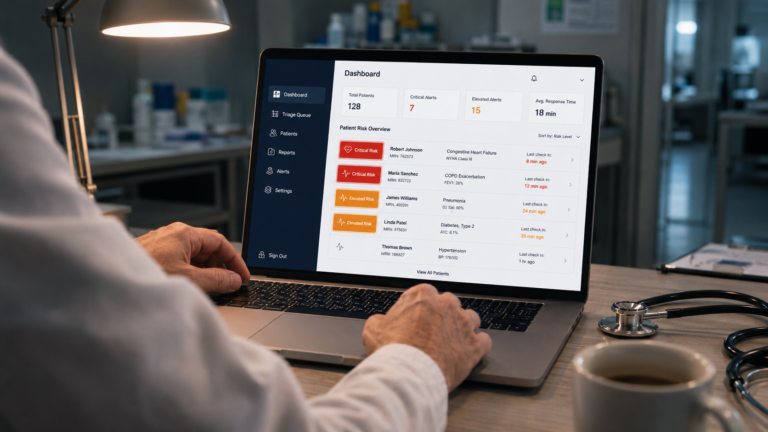
How Ambient AI Scribes Are Reshaping Health Informatics Careers in 2026
There’s a quiet revolution happening inside exam rooms across the country, and most people outside…
Top Health Informatics News From Q1 2026: What You Need to Know
Health informatics had a busy 1st quarter in the US, and honestly, a lot of…

The Hidden Costs of Bad Data in Healthcare
In hospitals, healthcare data is not just a record of what happened. It is the input that…

How Health Informatics Transforms Patient Outcomes
If you have ever wondered why a correct diagnosis does not always translate into better…
Healthcare Data Quality Framework to Fix Broken Dashboards
If you have ever shipped a dashboard you were proud of, only to watch it…
