
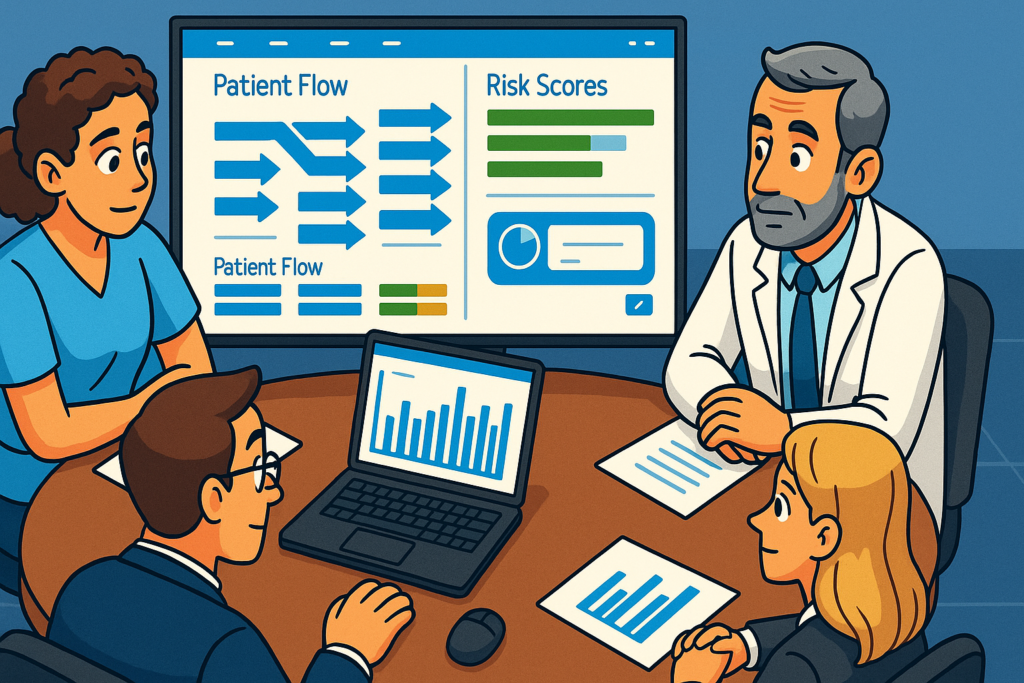
You’re likely living through the most important shift your role will ever see.
AI copilots can already suggest SQL, draft documentation, summarize research papers, and even outline dashboards. In many organizations, leaders are asking a quiet question: If AI can do this much, what do we still need analysts for?
The answer is not “better queries” or “fancier charts”.
The answer is you.
Your value is moving away from keystrokes and toward judgment, context, and the ability to turn messy clinical reality into decisions that change patient care. This article is written for you specifically as a healthcare data analyst who wants to stay ahead of that curve, not get run over by it.
We will walk through how GenAI and large language models are transforming analytics work, which human skills will separate the good from the great, what tech stack to build next, and where these changes open new career paths across the healthcare ecosystem.
How AI Is Reshaping Healthcare Analytics Workflows
Across industries, AI is no longer a side experiment. Recent surveys show that roughly 3/4 of companies worldwide already use AI in at least one business function, up from just over half the year before.
Generative AI is spreading even faster. One major cross industry survey found that almost 9 in 10 companies have either deployed or are piloting GenAI in their operations.
Healthcare is right in the middle of this wave. Recent syntheses of industry research suggest that AI adoption among healthcare organizations has risen from roughly 72% to about 85% in a single year, and more than 80% of those organizations report moderate or high return on investment. (Vention Teams)
So what does this look like in your day to day work as an analyst?
Common changes include:
- AI assisted query writing:
Copilots that help you draft SQL, validate joins, and explain complex queries step by step. - Automated documentation and summaries:
Tools that summarize meetings, generate report drafts, and produce first pass interpretations of trends in your dashboards. - Faster code and dashboard prototyping:
You can move from idea to first iteration far more quickly, especially for routine reports and data pulls. - Self service support for business users:
Leaders and clinicians can ask natural language questions on top of your curated data models, sometimes without involving you for simple asks.
If you only define yourself by the mechanical side of writing queries and building basic dashboards, this can feel like a threat.
In reality, these tools are removing the floor, not the ceiling. They wipe out the low complexity work that used to consume your time and make space for you to take on higher value problems.
The organizations that are getting value from AI are not replacing analysts. They are expecting more from them.

The Human Edge: What Still Differentiates You
When everyone has access to similar AI tools, the real differentiator becomes how you use them.
There are 3 pillars that remain deeply human and that only become more important as AI spreads.
Pillar 1: Problem framing
Gen AI is powerful at generating outputs. It is not good at deciding what is worth working on.
Problem framing is the skill of translating vague complaints into answerable questions.
Instead of accepting a request like:
“Build a dashboard for readmissions for our hospital”
You ask questions until you can define something actionable:
“Which readmissions are we worried about, for which population, over what time period, and what decision will change based on this metric?”
AI can help you brainstorm metrics or segmentations, but it cannot walk into a fraught meeting with nursing leadership, listen to the subtext, and decide which tradeoffs matter. That is your job.
Pillar 2: Domain expertise
Healthcare data is not just numbers. It embeds clinical workflows, reimbursement rules, regulatory requirements, and messy human behavior.
An LLM can generate a plausible query against a table called ENCOUNTERS. It does not understand that an “observation stay” might be billed differently from an “inpatient stay”, or that a readmission definition needs a clean index admission and a lookback period.
Your domain knowledge lets you:
- Catch nonsense before it reaches a clinician
- Design metrics that are clinically meaningful, not just mathematically convenient
- See where data is missing or biased because of workflow quirks
As AI adoption grows, many health systems report that they can deploy AI models, but only a minority describe high success across use cases like imaging or risk stratification. That gap often comes down to domain integration and workflow fit, not pure algorithmic power. (PMC)
Pillar 3: Communication and influence
Even perfect analysis is useless if no one acts on it.
Communication is more than dropping a dashboard link in someone’s inbox. It is the ability to:
- Tailor your story to a chief medical officer versus a charge nurse
- Explain uncertainty and tradeoffs without jargon
- Facilitate conversations about what to change and who will own that change
Gen AI can help you draft emails or slide outlines, but it does not carry the trust you build over repeated interactions with stakeholders.
In an environment where leaders are flooded with AI powered insights, the analyst who can drive aligned action will stand out.
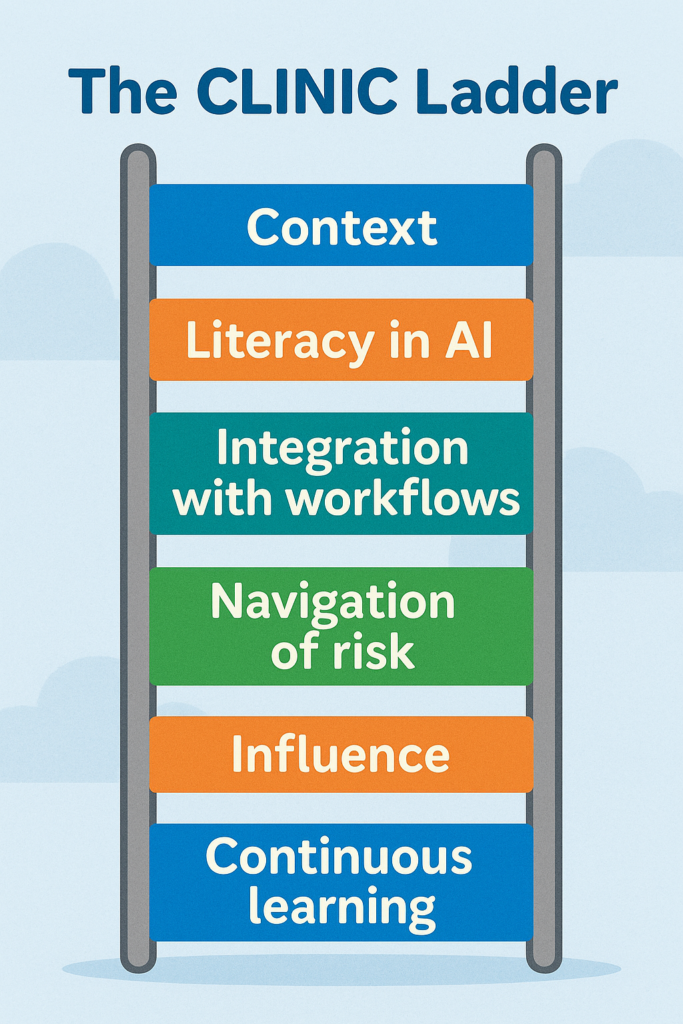
The CLINIC Ladder Framework
To make all of this practical, use the CLINIC Ladder as your roadmap.
C – Context
Before you open any tool, ask:
- What is the real problem for patients, clinicians, or the business
- How will someone use this analysis to make a decision
- What time frame and constraints are we working within
You might still use AI to explore questions or generate code, but you lead with context. That keeps you from building impressive yet irrelevant solutions.
L – Literacy in AI
You do not need to become an ML engineer.
You do need working literacy in:
- What gen AI and LLMs are good at, such as language tasks, summarization, pattern suggestions
- Where they fail, such as hallucinations, bias, or lack of up to date data
- How to design prompts and guardrails for analytics tasks
Think of this as learning how to work with a very fast but unreliable junior analyst.
I – Integration with workflows
The best analytics and AI work disappears into the workflow.
Examples:
- Embedding a readmission risk insight into the discharge planning process instead of a separate dashboard
- Adding an AI assisted note summarizer into an existing clinician interface rather than creating yet another screen
- Surfacing patient engagement predictions directly inside outreach tools
As the analyst, you are uniquely placed between data teams, product teams, and operations. You can see where insights should live to actually change behavior.
N – Navigation of risk
AI introduces new categories of risk.
You need enough understanding to raise the right flags around:
- Data privacy and PHI
- Bias and fairness in model outputs
- Clinical safety risks when AI suggestions influence care
- Regulatory considerations around documentation and billing
You do not make all of these decisions yourself, but you know when to bring in privacy, compliance, and clinical leaders.
I – Influence
Influence is a skill that can be built.
It includes:
- Asking better questions in stakeholder meetings
- Framing tradeoffs clearly
- Being transparent about limitations without undermining trust
- Following up consistently so partners experience you as reliable
AI can help you simulate objections or practice presentations, but your relationships are the real engine.
C – Continuous learning
The only constant in this space is change.
You need a system for ongoing learning that includes:
- Regular time on your calendar dedicated to reading, courses, or experimentation
- A simple log of experiments and lessons learned with AI tools
- Deliberate practice in both technical topics and healthcare content
The analysts who thrive will not be the ones who know every framework. They will be the ones who keep updating their mental models.
Building Your AI Ready Tech Stack
Now let’s get concrete. What should you actually learn next?
Think of your stack in three layers.
Layer 1: Core data and healthcare foundations
These do not go away.
- SQL at a strong intermediate level
You should be comfortable with joins, window functions, common table expressions, and query optimization basics. - Data modeling
Understanding star schemas, slowly changing dimensions, and how to design tables for analytics rather than just transactional use. - Healthcare data literacy
Claims, EHR data, enrollment files, common coding systems, care settings, and workflows. - One main BI or visualization tool
For example, Tableau, Power BI, or Looker, with strong skills in building user friendly dashboards.
AI can help you work faster with these, but it cannot replace understanding.
Layer 2: AI assisted analytics skills
Here you turn AI into a force multiplier.
- Working with copilots
Practice using SQL and Python copilots in a structured way. For example, generate code, then manually check logic and performance, and ask the model to explain any parts you do not fully understand. - Prompt patterns for analytics
Learn patterns like:
“First restate the question in your own words, then list the data you would need, then propose a step by step plan, then write the code.” - Document and test generation
Use AI to draft documentation, data dictionaries, and unit tests for critical queries and data pipelines. - Experimentation with LLM powered analytics tools
For instance, natural language query interfaces over your warehouse. The goal is not to outsource thinking, but to speed up exploration.
Layer 3: Modern data and AI ecosystem awareness
You do not need mastery in every tool, but you should be conversant in:
- Cloud data warehouses and lakes:
Such as Snowflake, BigQuery, or Redshift. Understand how they handle storage, compute, and access control at a high level. - Workflow orchestration and version control:
Basic familiarity with tools that schedule jobs and with Git for code management. - Feature stores and model deployment concepts:
Even if you do not build models, knowing how they are trained, validated, and monitored will help you collaborate effectively.
Across industries, many companies report that their advanced gen AI initiatives already achieve measurable return on investment, with a significant share delivering returns that meet or exceed expectations. (Deloitte)
That means organizations will keep investing. The analysts who can connect this modern stack to real healthcare problems will be in demand.
Career Paths in an AI World
If AI automates more of the technical grind, what roles open up for you?
Here are a few realistic paths.
Senior or Lead Healthcare Data Analyst
You deepen both your technical skills and your domain expertise. You become the person leaders call when there is a messy, ambiguous problem that crosses teams.
AI helps you cover more ground, but your value is your judgment and ability to guide others.
Analytics Engineer
You move closer to the data engineering side.
You design and build robust data models, pipelines, and reusable metrics that serve many use cases, often with self service layers for business users.
Your healthcare knowledge helps you make those models actually reflect reality, not just tables.
Healthcare Product Analyst
You embed with product teams that build patient engagement tools, clinician workflows, or AI supported applications.
You define success metrics, run experiments, design analytics features, and act as the voice of data in product decisions.
AI Translator
As health systems expand AI use, they need people who can sit between clinicians, data science teams, and vendors.
You help evaluate AI use cases, define success criteria, monitor performance, and translate concerns in both directions.
Across these paths, the analysts who combine the CLINIC skills with an AI ready tech stack will be positioned as strategic partners, not just report builders.
A 90 Day Action Plan
Big shifts feel less overwhelming when you have a concrete plan.
Here is a simple ninety day roadmap.
Days 1-30: Clarify your context and baseline
- List your top 3 recurring stakeholder groups and the decisions they care about most.
- Audit one of your key dashboards or recurring reports and write a short narrative about the decisions it should inform.
- Choose one gen AI or copilot tool and commit to using it daily for small tasks such as commenting code, summarizing meetings, or drafting documentation.
Days 31-60: Build targeted skills
Pick one technical area and one human skill.
- Technical example:
Deepen your window function skills and practice using an AI assistant to write sample queries, then manually optimize them. - Human example:
Practice problem framing. For two new requests each week, push yourself to ask at least five clarification questions before writing any code.
Document these experiments in a simple log. What worked, what failed, and what you learned.
Days 61-90: Integrate and showcase
- Choose one project where you will deliberately apply the CLINIC Ladder.
- Use AI to accelerate some pieces, but do explicit human checks on domain correctness and communication.
- At the end, create a short narrative case study that you can share with your manager. Emphasize how you framed the problem, how you used AI, and what changed for stakeholders.
This case study can become a powerful story in performance reviews, promotion conversations, and future job interviews.
More Articles on Informessor:
Top Health Informatics News From Q1 2026: What You Need to Know
Health informatics had a busy 1st quarter in the US, and honestly, a lot of…

The Hidden Costs of Bad Data in Healthcare
In hospitals, healthcare data is not just a record of what happened. It is the input that…

How Health Informatics Transforms Patient Outcomes
If you have ever wondered why a correct diagnosis does not always translate into better…
Healthcare Data Quality Framework to Fix Broken Dashboards
If you have ever shipped a dashboard you were proud of, only to watch it…
ChatGPT Health Breakdown: The Most Important Health Product of the Decade?
The next decade of healthcare will not be won by the flashiest sensor or the…
Fixing Emergency Department Delays: How Health Informatics Can Help
Walk into almost any busy emergency department and you will feel it before you measure…
Quick FAQ
Will AI take my job as a healthcare data analyst?
AI will take tasks, not your entire role. The analysts who cling only to low complexity technical work are at risk. Those who lean into problem framing, domain expertise, and influence become more valuable, not less.
What if my organization is behind on AI adoption?
That is an opportunity. You can become the internal champion who understands both healthcare context and AI potential, and who can design small, safe experiments that show real value.
Do I need to become an expert in machine learning?
No. You need literacy rather than deep specialization. A strong base in analytics plus the CLINIC skills will let you partner with data scientists and engineers effectively.
The future healthcare data analyst does not compete with AI on speed of typing. You win by owning the questions, the context, and the conversations that actually move care forward. AI becomes the amplifier for your thinking, not the replacement for it.